Showing posts with label the future. Show all posts

Wednesday, 4 March 2009

Searching by colour


I like this site that lets you search for images by their colour.

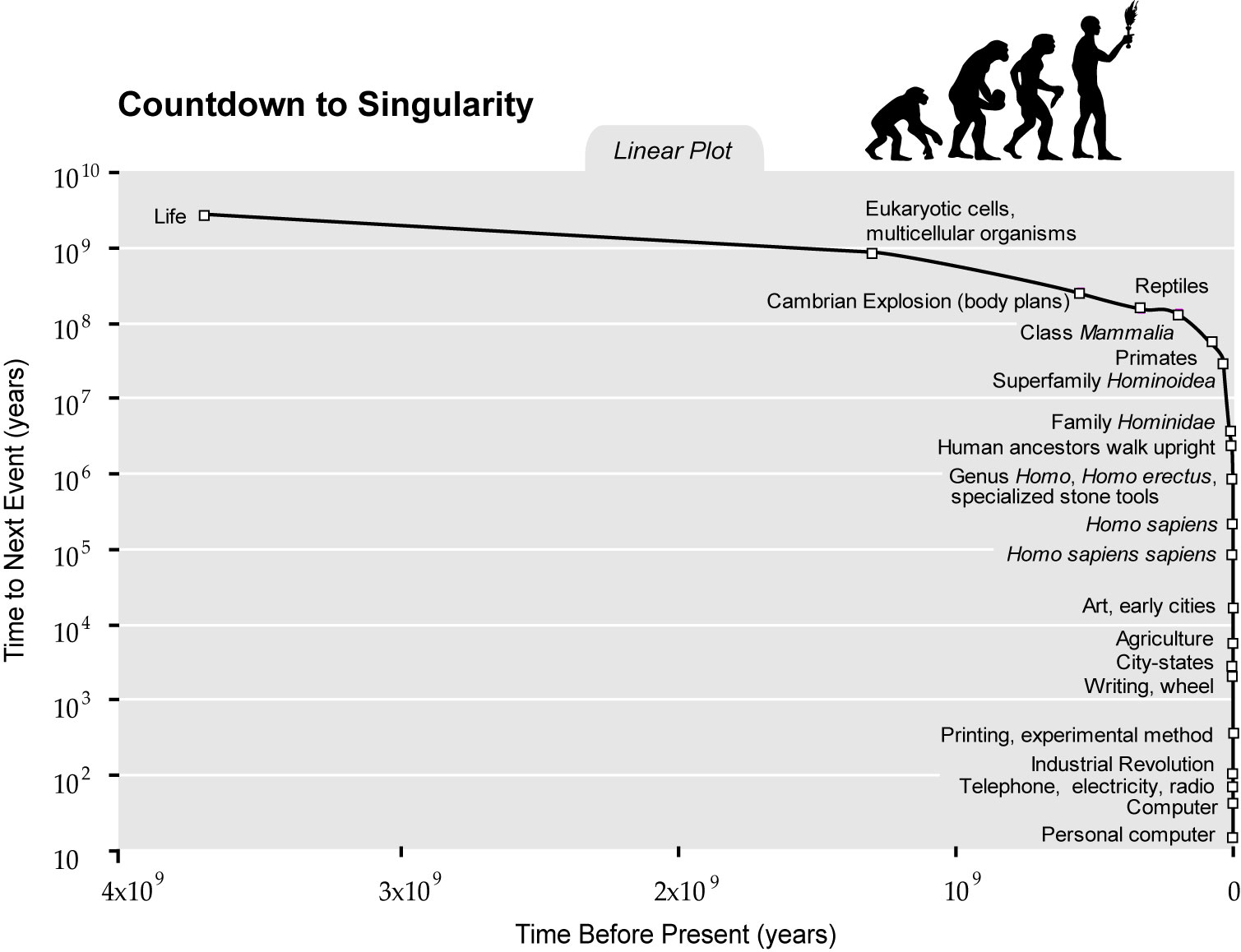
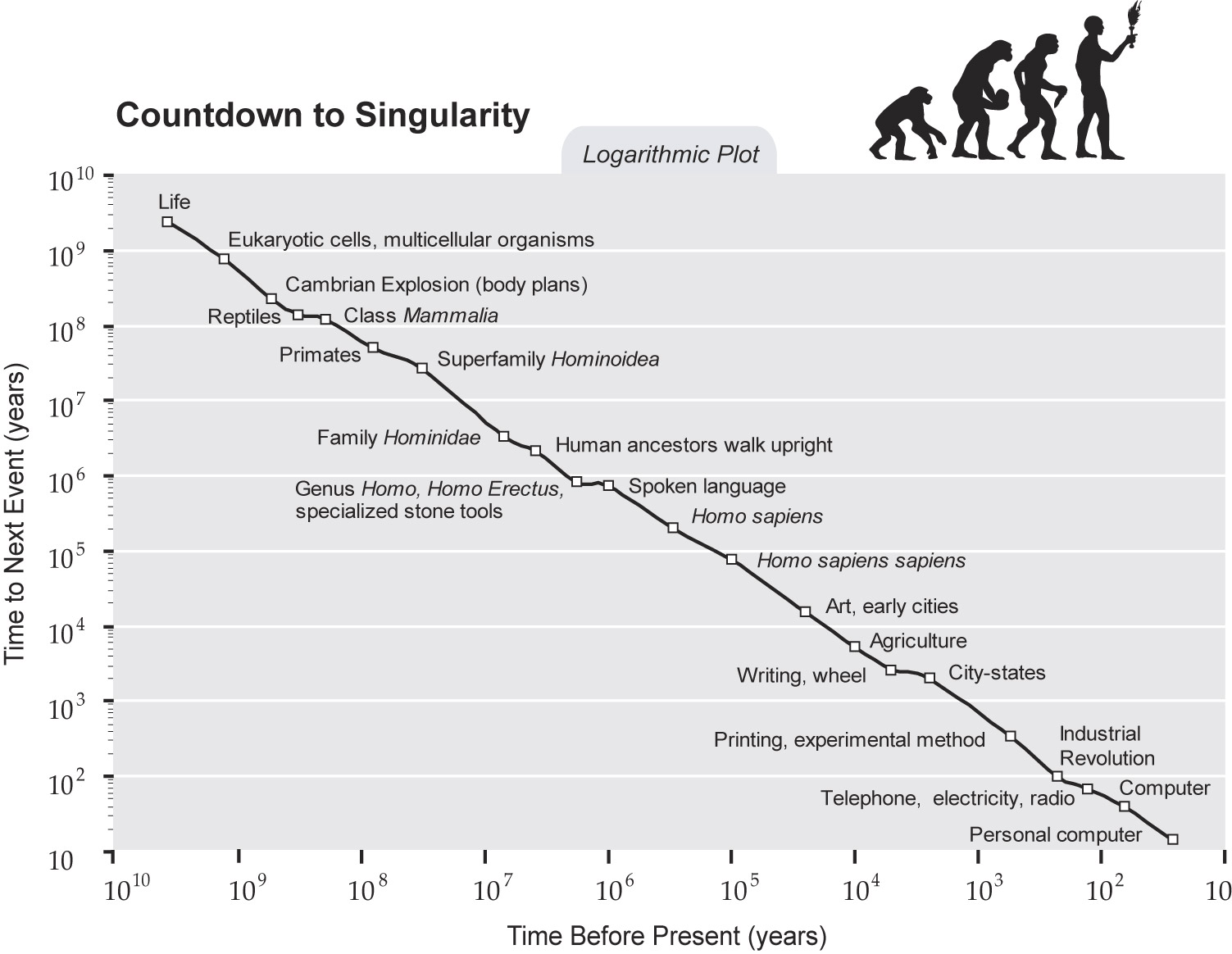
Ray Kurzweil's Charts on The Singularity


This site has all the charts from Ray Kurzweil's book 'The Singularity Is Near', which is all about the significance of the fact that a lot of technological stuff grows (or shrinks) at logarithmic speeds: that means it takes the same amount of time to grow (or shrink) by the same percentage. For example, if computer memory is 10 times faster now that it was five years ago, in five more years it will be 10 times faster again, or 100 times faster than it was five years ago. If the computer memory speed was 1 unit at the beginning, it would grow by 9 units in the first five years (to be ten times faster) but it would grow by 90 units in the next five years (to be a hundred times faster). The rate of growth is constant, so the amount of growth increases continually.

The chart above is one of the only charts that is not shown with logarithm units; it shows that the time between technological advance decreases at a logarithmic rate. This means that changes that used to be spaced centuries apart will soon come to be spaced seconds apart. Yikes! You can see the linear version of the same chart here, where this rate of change looks like a straight line because of the logarithmic units.

Saturday, 28 February 2009

The end of TV.


Today CTV (a big Canadian TV station) announced that they will lose $100 million this year, and write down their assets by $1.7 billlion, 3/4 of their previously-listed value. They also announced "Since we now lose significant amounts of money in conventional television, it is clear that our company would be in a better financial position if we closed our conventional television operations.", though they aren't planning (yet) to do that.

We are witnessing the beginning of the end of TV (but we are witnessing it on the Web).

Thursday, 5 June 2008

Petaflop barrier soon to go down?


Computer speeds are often measured in 'FlOPS' = floating point operations per second, essentially a measure of how many calculations the machine can do in a second (skipping over some technical details). A megaFlOPS is about one million floating-point operations per second. A gigaFlOPS is one thousand times faster (actually, 1024 times faster = 2 to the 10th power), or (roughly) one billion floating-point operations per second. Most desktop PCs can do a few (< 50) gigaFlOPs now. A teraFlOPS is one thousand (1024) times faster: roughly one trillion floating-point operations per second. Only a few machines in the world can do a teraFlOPS. Now IBM says their RoadRunner computer (pictured above) will soon bust through the petaFlOPS barrier, which is again 1024 times faster, or 1024 trillion FlOPS. You could play some cool video games on that baby.

Via: dvice.com