Showing posts with label singularity. Show all posts

Friday, 8 May 2009

Three related announcements?


I am starting to notice a lot of development on large-scale, well-funded attempts to make computers answer questions posed in ordinary language. Three in particular are of note:

i) IBM's 'DeepQA' Project: "IBM has unveiled the details of its plans to build a computing system that can understand complex questions and answer with enough precision and speed to compete on America's favorite quiz show, Jeopardy!."

ii.) Stephen Wolfram's Wolfram|Alpha: "Although it’s tempting to think of Wolfram|Alpha as a place to look up facts, that’s only part of the story. The thing that truly sets Wolfram|Alpha apart is that it is able to do sophisticated computations for you, both pure computations involving numbers or formulas you enter, and computations applied automatically to data called up from its repositories." (From the Wolfram|Alpha Blog)

iii.) The Large Knowledge Collider Project: "The aim of the EU FP 7 Large-Scale Integrating Project LarKC is to develop the Large Knowledge Collider (LarKC, for short, pronounced “lark”), a platform for massive distributed incomplete reasoning that will remove the scalability barriers of currently existing reasoning systems for the Semantic Web."

Will we soon see a leap forward in computer intelligence? Stay tuned! These are exciting times!

[Image from The Large Knowledge Collider Project]

Wednesday, 4 March 2009

Ray Kurzweil's Charts on The Singularity


This site has all the charts from Ray Kurzweil's book 'The Singularity Is Near', which is all about the significance of the fact that a lot of technological stuff grows (or shrinks) at logarithmic speeds: that means it takes the same amount of time to grow (or shrink) by the same percentage. For example, if computer memory is 10 times faster now that it was five years ago, in five more years it will be 10 times faster again, or 100 times faster than it was five years ago. If the computer memory speed was 1 unit at the beginning, it would grow by 9 units in the first five years (to be ten times faster) but it would grow by 90 units in the next five years (to be a hundred times faster). The rate of growth is constant, so the amount of growth increases continually.

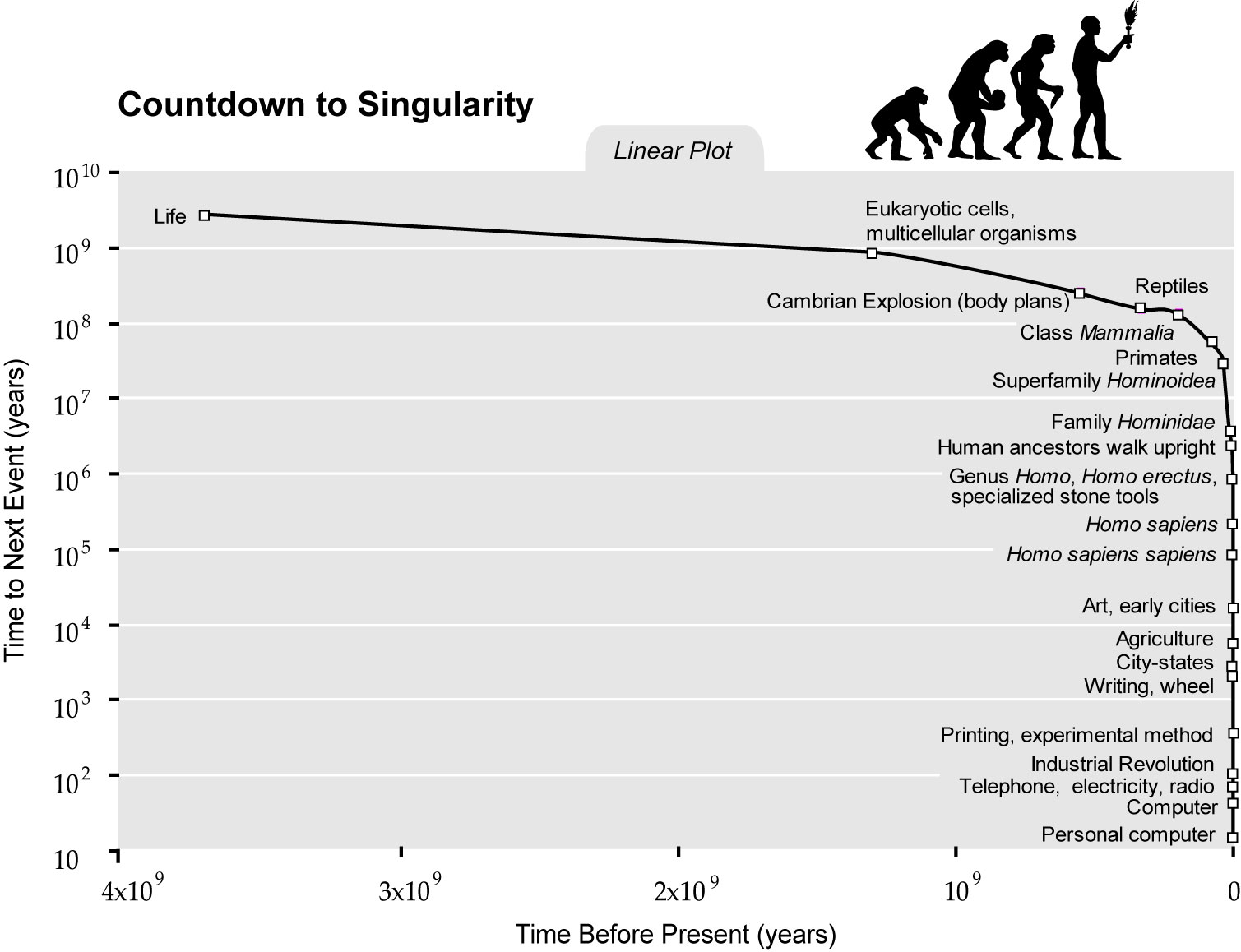
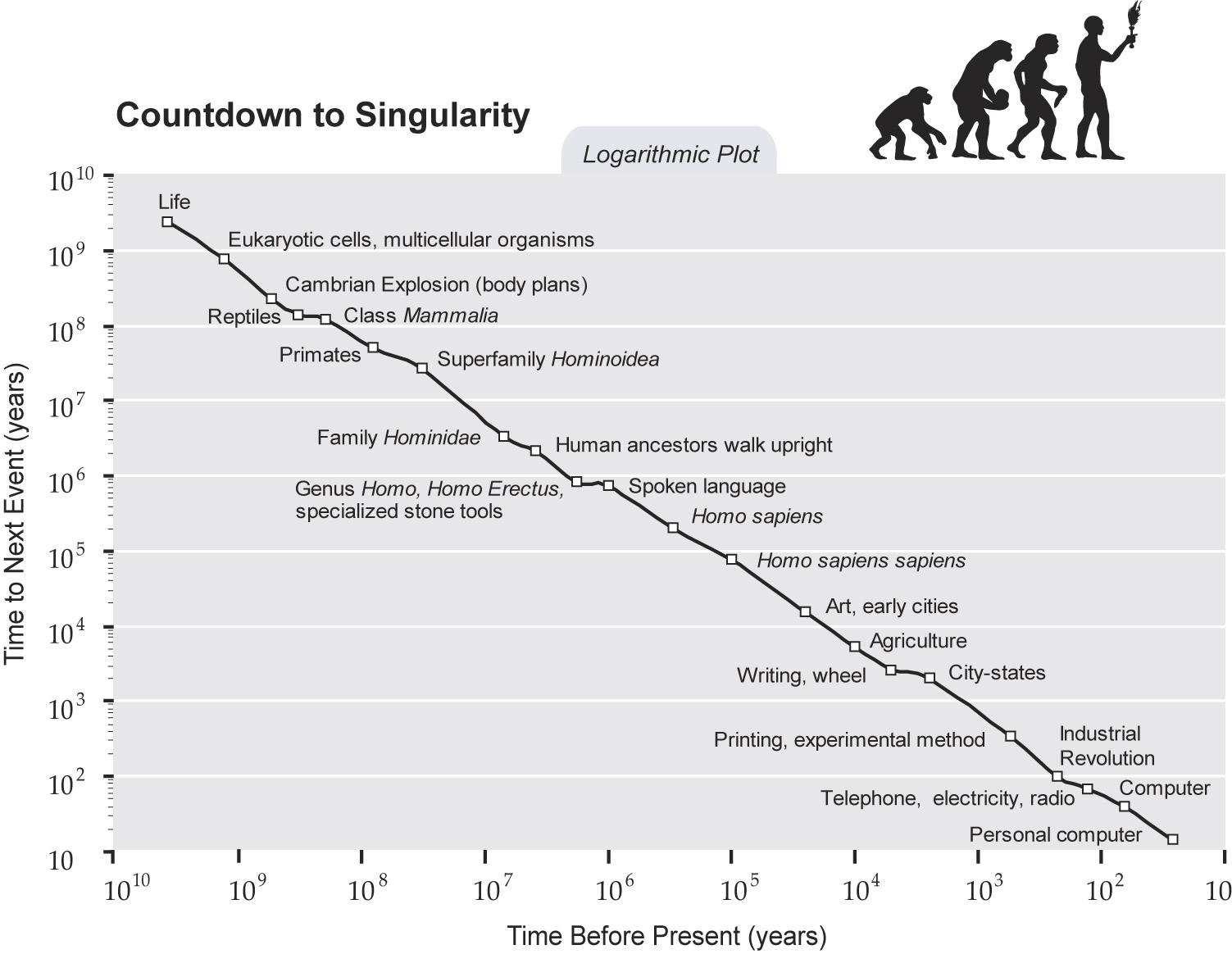
The chart above is one of the only charts that is not shown with logarithm units; it shows that the time between technological advance decreases at a logarithmic rate. This means that changes that used to be spaced centuries apart will soon come to be spaced seconds apart. Yikes! You can see the linear version of the same chart here, where this rate of change looks like a straight line because of the logarithmic units.